The Basics
What is the Protect Grove City campaign?
We’ve already gathered enough signatures to place the Community Consent Amendment on the November 2026 ballot as a Grove City Charter amendment. The petition phase is done — now it comes down to building support. We need you, your friends, and your family to help get the word out and support getting this amendment added to the Charter this November.
What is the Community Consent Amendment?
The Community Consent Amendment is a proposed addition to Grove City’s City Charter. It creates a mandatory referendum process: before any qualifying large-scale industrial development can receive any city approval, registered Grove City voters must first approve it at the ballot box. No vote, no approval. Full stop.
Why is this needed right now?
Earlier this year, a developer sought approval to build a massive 310-acre data center campus in Grove City. Residents pushed back hard, and that project was turned away. But under current law, a future data center could still happen without the public getting a real say in the matter. Beating back one project isn’t enough — we need to cement this protection into the Charter so residents always have a voice before a project like that moves forward.
What Triggers the Referendum Requirement
What kinds of projects would require a public vote?
If we pass the CCA, any proposed project that meets ANY ONE of the following thresholds would trigger the amendment:
- 50 or more acres in total project footprint
- More than 20 megawatts of electrical demand at peak capacity
- More than 500,000 gallons of water consumption per day
A project only needs to hit one of these. Not all three.
Here’s how that gets determined in practice: every rezoning, annexation, conditional use, or planned development request (or even a pre-application inquiry) goes through a threshold test. If it meets any one of the three thresholds, the City Law Director issues a written determination on whether it qualifies as a “Heavy Industrial Development.” That determination can be appealed by the applicant or the public within 30 days; if appealed, City Council hears it and issues the final verdict. If the project is found to be Heavy Industrial, the amendment applies and the project must fulfill its requirements, including the public referendum.
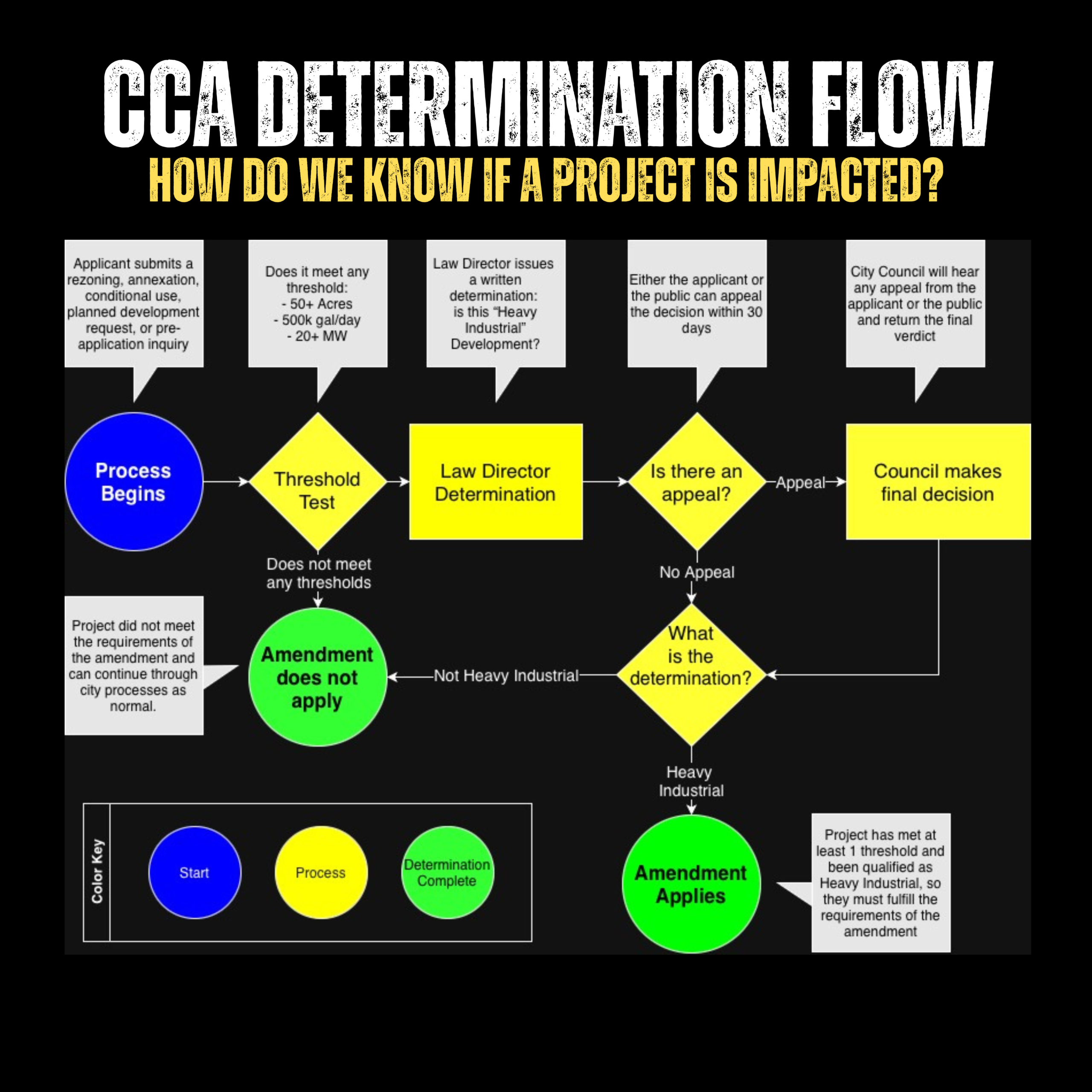
The CCA determination flow, from application to final decision.
Why those specific numbers?
The thresholds are calibrated to capture truly massive industrial projects while leaving everyday commercial and medical development untouched. For comparison, American Nitrile (~30.14 acres) and the Meijer development (~28.12 acres) both sit comfortably under every threshold and wouldn’t trigger the requirement. Mount Carmel Grove City Hospital (a major development residents generally support) sits at roughly 61.7 acres — it does cross the acreage threshold, but as an M-1 zoned medical facility it’s exempt. A 310-acre data center campus would trigger the requirement outright.
Could a developer split up a project to get under the thresholds?
No. The amendment includes an anti-circumvention rule. If a company tries to split one large project into smaller pieces, even under different company names or filed at different times, the total footprint is still counted together. The law looks at substance, not paperwork structure.
Are existing businesses affected?
No. Facilities already operating when the amendment takes effect are grandfathered. They register their current operating levels and continue operating as-is. The referendum requirement only applies to new projects seeking approval going forward.
How the Public Vote Works
Who pays for the election?
The developer pays. Not taxpayers. The applicant is required to fund a dedicated escrow account covering all costs of the referendum before the process begins.
What happens if voters say yes?
The project can proceed to standard city approval processes: zoning, building permits, and so on. A yes vote clears the referendum hurdle but doesn’t bypass other normal requirements.
What happens if voters say no?
No city approval of any kind can be granted. The developer cannot reapply with the same or a substantially similar project for 24 months. A no vote has teeth.
What about residents in neighboring townships?
Grove City residents vote on the referendum. Because a project built near the city border could significantly impact township neighbors, the amendment requires Grove City to reach out to affected townships to explore a joint process. If no agreement is reached, township residents still get an advisory ballot. Their results are announced publicly and council must explain in writing if they proceed against township opposition.
Ongoing Protections If a Project Is Approved
Does a yes vote mean the project can do whatever it wants afterward?
No. The amendment includes enforceable community impact standards that apply for the entire life of the facility, including:
- Noise limits measured at the nearest property line (not averaged over time)
- Infrasound (low-frequency vibration) limits, with pre-construction baseline measurements locked in for comparison
- Light pollution limits, including upward light directed at the sky
- Ground vibration limits set at the threshold of human perception
Does this make the moratorium task force unnecessary?
Not at all. The two efforts work together. The Community Consent Amendment establishes the floor: minimum protections that voters lock into the City Charter that no future Council can take away. The moratorium task force can build on top of that floor through the normal ordinance process. Think of it this way: the amendment ensures residents get a vote; the task force ensures that if residents say yes, the project operates under the strongest possible rules.
What if the company wants to expand after it’s approved?
Any material change (a 10% or greater increase in acreage, power draw, or water use) triggers a new public vote. Changes are always measured from the original approved baseline. A company can’t grow 9% per year to avoid the threshold.
How is compliance monitored?
Every three months, the operator must file a detailed compliance report covering power, water, size, and all impact measurements. Reports must come from an independent, city-approved firm. Not the company’s own instruments. A company officer signs each report under penalty of law. The City reviews within 15 business days and all results are public.
What if the company violates the rules?
Fines are escalating. They start at $25,000 per day and reach $500,000 per day by the fourth month of non-compliance. Filing a false report is a separate $50,000 per violation and can result in criminal charges. If the company knew it was approaching a limit and did nothing, fines triple. The City can also seek a court order to immediately reduce operations.
What if the city doesn’t enforce the rules?
Any Grove City resident can sue in Franklin County Common Pleas Court to compel enforcement, without needing the City’s permission or anyone else’s agreement. If the resident wins, the company pays their legal fees. Enforcement doesn’t depend on political will at City Hall.
Common Questions & Concerns
Doesn’t this hurt economic development?
No, and that framing gets it backwards. Projects above the thresholds can absolutely still happen in Grove City. The amendment doesn’t block anything; it simply requires the company to make its case to the people who actually live here, and lets those residents decide. Grove City stays wide open for business. Most everyday development — restaurants, offices, retail, small manufacturers — doesn’t come close to the thresholds. And even some larger projects clearly aren’t heavy industrial to begin with: Mount Carmel Grove City Hospital’s ~61.7-acre campus crosses the acreage line on paper but is exempt as an M-1 zoned medical facility. For the rare project massive enough to permanently reshape a neighborhood, voters get the final word.
Can a future council undo this?
No. As a charter amendment approved by voters, it can only be changed by another vote of the people. A council vote can’t touch it.
Is this legal?
The amendment was drafted with attention to Ohio home rule authority, Commerce Clause concerns, and state preemption issues. It applies threshold-based impact triggers rather than naming specific industries, which is the legally strongest approach. It has been reviewed by independent legal counsel and revised to address identified vulnerabilities before circulation.